
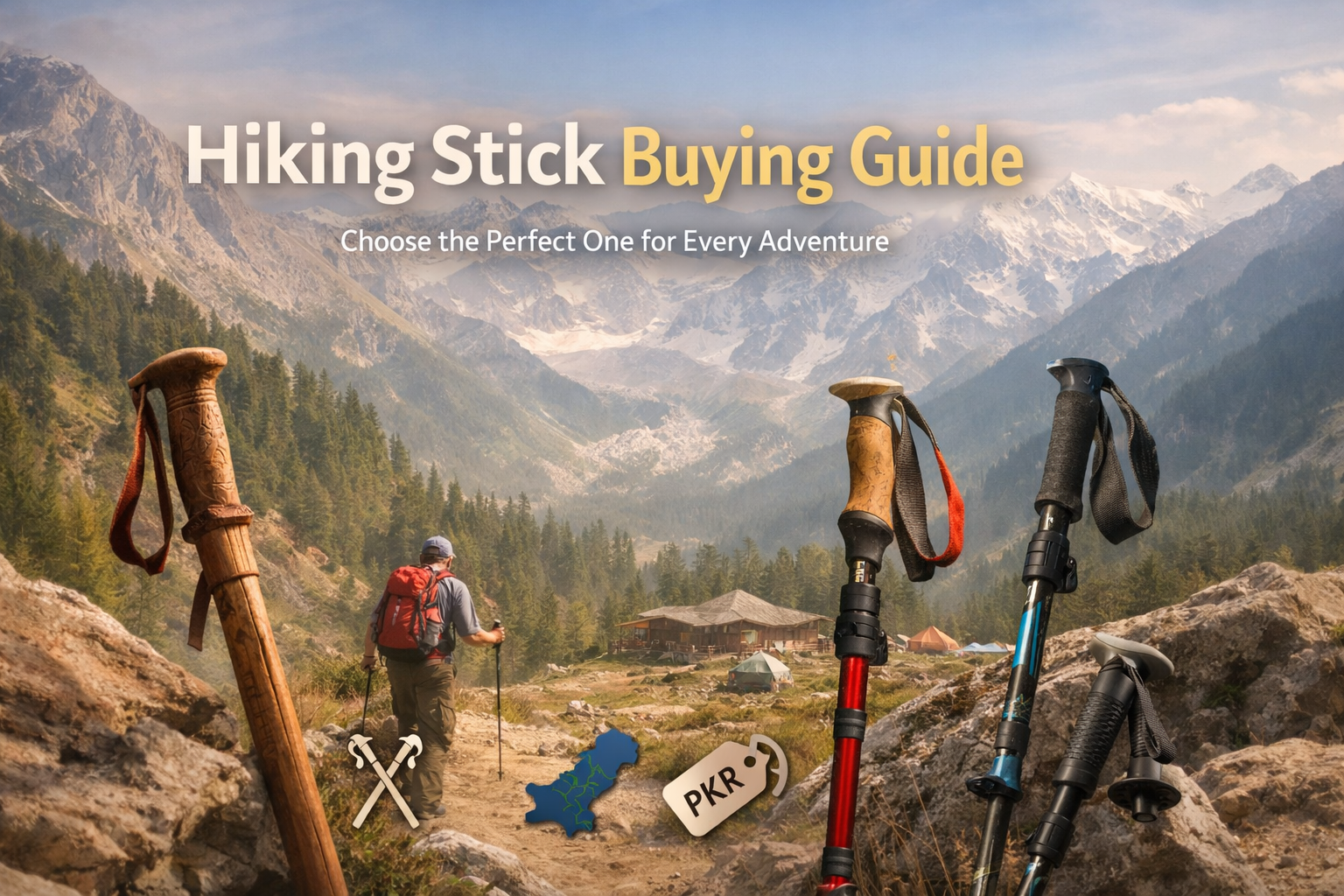
Hiking Stick Buying Guide to Choose the Perfect One for Every Adventure
A hiking stick is not just a walking aid, it is a trail companion that reduces knee stress by up to 25%, improves balance on rocky terrain, and can genuinely make or break a mountain adventure. In Pakistan, where trails like Nanga Parbat base camp, Fairy Meadows, and the Karakoram routes attract thousands of hikers every year, choosing the right hiking stick has never been more important.
Whether you are a weekend trekker conquering Margalla Hills in Islamabad or a serious mountaineer preparing for K2 base camp, this guide walks you through everything — types, materials, sizing, prices in Pakistan, and the most common buying mistakes to avoid.
What is a Hiking Stick, and Why Does It Matter?
A hiking stick (also called a trekking pole) is a handheld support tool designed for use on uneven, steep, or slippery terrain. Unlike a simple walking cane, a quality hiking stick absorbs shock, provides stability, and reduces fatigue over long distances.
For Pakistani hikers specifically, trails often involve loose gravel, river crossings, and elevation changes of 2,000 - 4,000 meters. In such conditions, a good hiking stick can:
- Reduce load on your knees and ankles by distributing weight to your arms
- Improve posture and reduce back pain on long ascents
- Provide a third (and fourth) point of contact for balance on narrow ridges
- Help test the depth of muddy patches or shallow stream crossings
- Double as a tent pole or emergency support when needed
Types of Hiking Sticks Available in Pakistan
1. Wooden Hiking Sticks
Wooden hiking sticks are the most traditional option and remain popular in Pakistan for their natural feel and affordability. Typically made from bamboo, walnut, or pine, they are heavier than modern alternatives but are durable, eco-friendly, and culturally resonant, often hand-carved and personalized.
- Best for: casual day hikes, lower-altitude trails, budget-conscious hikers
- Weight: 400 - 700g per stick
- Drawback: Cannot be adjusted in height; no shock absorption
2. Adjustable Hiking Sticks
An adjustable hiking stick lets you change the length depending on terrain, shorten it on ascents, extend it on descents. Most use a twist-lock or flip-lock mechanism. This is the most versatile choice for Pakistani trails that combine flat valleys with steep climbs.
- Best for: mixed-terrain treks, multi-day adventures
- Key feature: Height range typically 65–135 cm
- Tip: Always choose flip-lock over twist-lock, it is more reliable and easier to adjust with gloves
3. Anti-Shock Hiking Sticks
An anti shock hiking stick features an internal spring mechanism in the lower shaft that absorbs the impact of each step. This is particularly valuable when descending steep terrain, protecting your wrists, elbows, and shoulders from repetitive strain.
- Best for: knee or joint pain sufferers, descents, elderly hikers
- Added cost: Typically PKR 500–1,500 more than non-shock models
4. Foldable Hiking Sticks
A foldable hiking stick collapses into 3–4 sections, making it highly packable. Popular among trail runners and lightweight backpackers, these are easy to attach to a backpack when not in use. They are less robust than full-length sticks under heavy loads, however.
- Best for: ultralight hikers, day trips, travel-friendly packing
- Packed length: typically 30–40 cm
5. Mountain Hiking Sticks (Heavy-Duty)
Mountain hiking sticks are reinforced poles designed for high-altitude, technical terrain — glaciers, scree slopes, and snowfields. They often come with interchangeable baskets (wide snow baskets vs narrow trekking baskets) and carbide or steel tips for grip on ice.
- Best for: Karakoram, Himalayas, Hindukush, high-altitude routes
- Material: Carbon fibre or high-grade 7075 aluminium
Hiking Stick Comparison Table: Which One Is Right for You?
|
Type |
Best For |
Weight |
Shock Absorption |
Price Range (PKR) |
|
Wooden Hiking Stick |
Casual, budget hikes |
400–700g |
None |
500 – 2,000 |
|
Adjustable Stick |
Mixed terrain, all-round |
250–400g |
Optional |
1,500 – 5,000 |
|
Anti-Shock Stick |
Descents, joint pain |
280–420g |
Built-in spring |
2,500 – 7,000 |
|
Foldable Stick |
Ultralight, packable travel |
180–300g |
Optional |
2,000 – 6,500 |
|
Mountain/Heavy-Duty |
High altitude, glaciers |
300–450g |
Yes (advanced) |
4,000 – 15,000+ |
Hiking Stick Size Guide by Height (Pakistan Standards)
Choosing the wrong length is the most common mistake Pakistani hikers make. Use this table as your baseline, then fine-tune using the 90-degree elbow rule (grip the stick with your arm at a 90-degree angle — that is your correct length).
|
Hiker Height |
Recommended Stick Length |
Terrain Adjustment |
|
Under 5'2" (157 cm) |
100 – 105 cm |
Shorten 5 cm for steep descents |
|
5'2" – 5'6" (158–168 cm) |
105 – 110 cm |
Shorten 5 cm for steep descents |
|
5'6" – 5'10" (169–178 cm) |
110 – 120 cm |
Lengthen 5 cm for flat terrain |
|
5'10" – 6'2" (179–188 cm) |
120 – 125 cm |
Lengthen 5 cm for flat terrain |
|
Over 6'2" (188+ cm) |
125 – 135 cm |
Use maximum extension on descents |
Hiking Stick Price in Pakistan (2026 Market Overview)
Hiking stick prices in Pakistan vary widely depending on brand, material, and features. Here is a realistic overview of what you can expect to pay in 2026:
|
Category |
Material |
Hiking Stick Price (PKR) |
Where to Buy |
|
Budget / Local |
Wood / Basic Aluminium |
PKR 500 – 2,000 |
Local markets, roadside shops |
|
Mid-Range |
Aluminium alloy (6061) |
PKR 2,000 – 5,500 |
Sports shops, 95stores.pk |
|
Premium |
Aluminium 7075 / Carbon fibre |
PKR 5,500 – 12,000 |
Outdoor gear stores, 95stores.pk |
|
Professional / Import |
Full carbon fibre (brand) |
PKR 12,000 – 35,000+ |
Authorised importers, online |
5 Common Mistakes Pakistanis Make When Buying a Hiking Stick
1. Buying Based on Price Alone
A cheap local wooden stick for PKR 400 feels like a bargain — until it snaps on a rocky descent at 3,000 metres. For serious trails, invest in at least an aluminium mid-range stick. The cost of a sprained wrist or twisted ankle far exceeds the price difference.
2. Using the Wrong Height Setting
Most hikers set their stick at a random height and never adjust it. This causes shoulder fatigue and poor posture. Always use the 90-degree elbow rule and adjust shorter for uphills, longer for downhills.
3. Ignoring the Grip Material
Pakistani summers mean sweaty palms. A hard plastic grip becomes slippery, causing blisters. Choose cork or foam grips — they absorb moisture, stay comfortable in heat, and reduce vibration. Ergonomic grip shape also reduces wrist strain.
4. Skipping the Wrist Strap
Wrist straps are not just accessories, they prevent you from gripping the stick too tightly (which causes fatigue) and stop you from losing it on a fall. Many Pakistani hikers ignore straps entirely. Learn to loop your hand through the strap correctly — it makes a significant difference on technical terrain.
5. Buying Only One Stick
One stick is better than none, but two sticks are dramatically better than one — studies show that using a pair reduces energy expenditure by up to 23% on long hikes. Most serious hikers in Pakistan who switch to using two poles never go back.
Pro Tips to Get the Most Out of Your Hiking Stick in Pakistan
- Rubber tip protectors: Always carry rubber tip caps. They protect the metal tip when walking on roads or inside transport, and they are essential on marble or tiled mosque floors when hiking near shrines.
- Snow baskets vs trekking baskets: If you are hiking above 3,500 metres in winter, swap to wide snow baskets (included with most mountain sticks) to prevent sinking into soft snow.
- Cleaning after river crossings: Rinse and dry your sticks after water crossings. Sand and grit inside the locking mechanism wear it out quickly — a common issue on Kaghan and Swat valley trails.
- Carbon fibre vs aluminium: Carbon fibre is lighter but can shatter under sudden lateral stress. For rocky Pakistani terrain with unpredictable conditions, aluminium is more forgiving and cheaper to replace.
- Store unlocked: Always loosen flip-lock or twist-lock mechanisms when storing your sticks. Leaving them locked under tension weakens the mechanism over time.
Who Should Buy a Hiking Stick, and Where to Get the Best Ones in Pakistan
A hiking stick is right for you if:
• You hike trails above 2,000 metres in elevation in Pakistan's northern areas
• You have knee, back, or joint concerns
• You carry a loaded backpack of 10 kg or more
• You are a beginner who wants extra confidence and balance on uneven ground
• You are planning multi-day treks like Nanga Parbat Base Camp, Concordia, or Ratti Gali
For the best hiking stick prices in Pakistan with reliable quality and fast delivery, visit 95stores.pk, a trusted Pakistani outdoor and travel gear store offering adjustable, foldable, anti-shock, and mountain hiking sticks across all budget ranges. Whether you need a sturdy wooden hiking stick for a Margalla day hike or a premium carbon fibre pole for a Karakoram expedition, you will find a curated selection matched to Pakistani terrain and needs.
Conclusion: The Right Hiking Stick Changes Everything
Choosing the right hiking stick is not complicated once you know what to look for. Match your stick type to your terrain, size it to your height, and invest in at least mid-range quality for anything beyond a gentle day walk. In Pakistan's diverse and demanding mountain landscape, the right hiking stick is not optional equipment; it is an essential piece of kit.
Key takeaways: adjustable anti-shock sticks suit most Pakistani hikers; wooden hiking sticks are fine for casual use; foldable sticks are best for packability; always size correctly; and always use two poles for maximum benefit on long treks.
Frequently Asked Questions About Hiking Sticks in Pakistan
Q1: What is the best hiking stick for beginners in Pakistan?
An adjustable aluminum hiking stick with a flip-lock grip, priced PKR 2,000–4,000, is best. Suits Kaghan, Swat, and Galiyat trails. Choose anti-shock for downhill sections.
Q2: What is the hiking stick price in Pakistan in 2026?
PKR 500 for wooden sticks, PKR 2,000–5,500 for reliable mid-range, and PKR 5,500–15,000 for premium mountain hiking sticks.
Q3: Are wooden hiking sticks good enough for Pakistani trails?
Yes, for casual low-altitude hikes like Margalla Hills or Murree. For trails above 3,000 meters, aluminum or carbon fiber is strongly recommended.
Q4: What is an anti-shock hiking stick, and do I need one?
It has an internal spring that absorbs impact, protecting wrists and joints. Strongly recommended for descents and hikers with joint issues.
Q5: How do I choose the right hiking stick length for my height?
Bend your elbow to 90° — that is your correct length. Under 5'2" → 100–105 cm; 5'6"–5'10" → 110–120 cm; above 6'2" → 125–135 cm.
Q6: Is a foldable hiking stick strong enough for mountain use?
Yes, for standard trekking. For technical routes or loads above 20 kg, a full-length adjustable stick is more reliable.
Q7: Can I carry a hiking stick in the airplane cabin luggage?
No. Hiking sticks must go in checked baggage on all airlines. Foldable sticks packed inside a bag are generally accepted at check-in.
Q8: What is the difference between a hiking stick and a trekking pole?
The terms are interchangeable. Trekking poles are modern and adjustable; hiking sticks include traditional wooden options. Both serve the same purpose on the trail.
Q9: How do I maintain my hiking stick to make it last longer?
Rinse after muddy use, dry before storage, and loosen locks when not in use. Replace rubber tip caps regularly for longer life.
Q10: Where can I buy the best hiking sticks online in Pakistan?
Visit 95stores.pk for adjustable, foldable, anti-shock, and mountain hiking sticks with delivery across Pakistan.

Written by Ali Abbass